







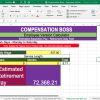


Compensation Boss: 13th Month Pay Calculator Employees Version
₱59.00
Product Description (in English) – Compensation Boss
13th Month Pay Calculator; See Product Description in Filipino / Tagalog below
This product is intended for employees as users giving them opportunity to have a hassle-free way to approximately compute their 13th month pay.
This features a file saved in Excel Microsoft 365, Version 16.54. User has to have such specification or its equivalent. The file offers quick way to determine 13th month pay by simply inputting the basic salary earned per payroll (“kinsenas at katapusan”).
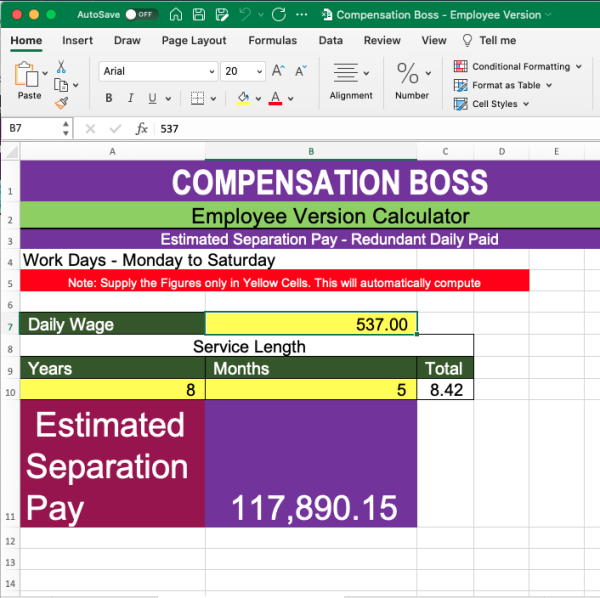
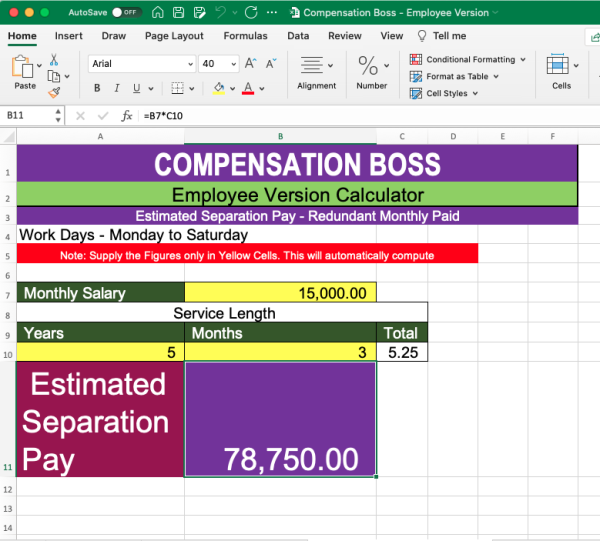
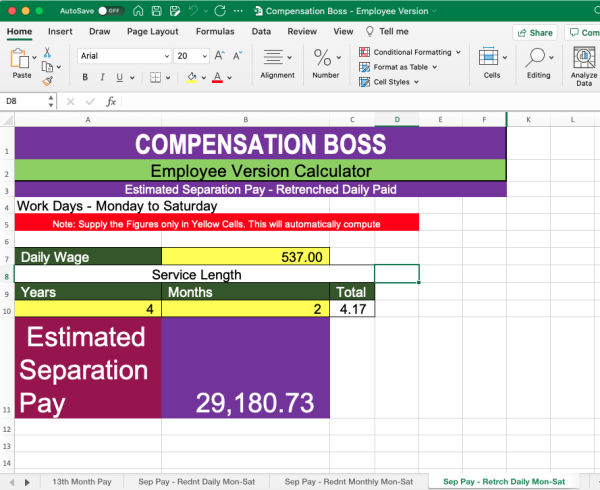
Results are computed automatically. Bonus sheets include redundancy separation pay calculator for both daily paid and monthly paid employees.
Retrenchment pay calculator, retirement pay calculator, and the service incentive leave (SIL) pay calculator. At an introductory price of just PhP59.00, this will be a big help to workers who need to have an immediate answer to their approximate 13th month pay benefits.
Product Description (in Filipino / Tagalog)
Ang produktong ito ay dinisenyo para sa mga empleyado upang mabigyan sila ng pagkakataon na magkaroon ng mabilis at epektibong paraan upang alamin ang halaga ng kanilang makukuhang 13th Month Pay na benepisyo.
Ang produktong ito ay naka-save sa file na Excel Microsoft 365, Version 16.54. Ang bibili at gagamit nito ay dapat mayroong nasabing specification, application, o programa sa kanyang kompyuter o katumbas nito. Ang nasabing file ay nagbibigay nang mabilis na paraan upang alamin ang 13th Month Pay na makukuha sa pamamagitan lamang ng pag-encode o pag type ng halaga ng basic salary na kinita kada sahod (“kinsenas at katapusan”).
Ang resultang makukuha ay kaagad na kinakalkula. May bonus sheets na kasama para sa pag-kompyut ng separation pay para sa mga empleyadong arawan ang sahod at buwanan.
Mayroon ding Retrenchment pay calculator, retirement pay calculator, at service incentive leave (SIL) pay calculator. Ang introductory price na PhP59.00 ay malaking tulong para sa mga manggagawa na kailangan magkaroon ng mabilisang sagot sa halaga ng 13th month pay benefits na makukuha.

Related Products
-

Release, Waiver and Quitclaim of Deceased Employee by Sole Heir – Soft Copy Editable Template
₱895.00DESCRIPTION OF RELEASE, WAIVER AND QUITCLAIM OF SOLE HEIR FOR THE DECEASED EMPLOYEE WHO IS RETIRABLE
This is a soft copy template saved in Word File and editable in Word Document.
This contains the sample terms, conditions, clauses, and provisions of the contract described.
See the Description below to view the Contents of this soft copy template.
This template applies to cases where the employee who is entitled to retirement has resigned but died prior to claiming the retirement benefit. The one claiming the benefit is the child (son in this template).
Further, the company advanced certain expenses in the hospital for the deceased employee.
The claimant is a sole heir. Meaning he is alone and there are no other heirs requiring the Extrajudicial Settlement of Estate. Likewise, he has executed an Affidavit of Sole Heir.
The relative and/or spouse here is the one claiming damages against the company. While the company has several defenses in this case, the company may decide to buy peace and provide financial assistance.
In doing so, the release thereof should be documented to prevent any further action from the claimant against the company or its officers. Thus, a Release, Waiver & Quitclaim may be executed by the spouse, common law partner, or any person acting in behalf of the interests of the deceased person.
Read more..
The draft template here addresses the following concerns:
- The claimant should release and remiss the company and its officers from any claim;
- The claimant clearly states the relationship to the deceased;
- The claimant does not make any statement that will incriminate or establish criminal liability against the alleged actor or any person acting for the company;
The following terms are stated:
- Claimant is of legal age,
- Residence of the claimant
- Declaration of claimant as the duly authorized representative of the family for and in behalf of the deceased person
- Name of the deceased person
- Relationship of the claimant to the deceased person such as being the common law partner / spouse, etc.
- Description of the incident without specifying any suspect or declaring liability;
- Decision of the company to release the fund due for the above deceased as well as financial assistance;
- Statement of release, remiss and forever discharge of the company, its stockholders, Directors, Officers, President, Treasurer, executives, managers, employees, representatives and any other persons working or dealing for and in behalf thereof, from any and all liabilities, damages or injuries caused to claimant and his family or may be caused, as a result of the service not having materialized, and for any other such liabilities, damages or injuries which may now or in the future arise as a result thereof;
- If found hereinafter that there would be any other consequential or resulting damage, liability or injury, whether actual, moral, exemplary or in any other form of damage, not evident as of that time, that the amount given shall constitute as full and final settlement for such damage, liability or injury;
Statement of voluntary, free and unconditional declaration that the claimant and his family have no further claims or right of action, whether past, present, future or contingent, of whatever nature - Statement of waiver of any and all claims and causes of actions or judgments of any tribunal;
- Statement not to institute any action, whether civil, criminal, labor or administrative against the company, its directors, officers, employees, agents and clients;
- Statement that any and all actions which may have been commenced are deemed and considered voluntary withdrawn by me and he will no longer testify or continue to prosecute said action(s); and
- Statement that the claimant fully understands all the statements made.
close
-


Contract for Project Employment – Filipino/Tagalog – Soft Copy Editable Template
₱1,648.00This is a soft copy template saved in Word File and editable in Word Document.
This contains the sample terms, conditions, clauses, and provisions of the contract described.
See the Description below to view the Contents of this soft copy template.
Project employment is an exception to the rule on regular employment if all the requisites are complied with.
A project employee under now Article 295 of the Labor Code, as amended, is one whose employment has been fixed for a specific project or undertaking, the completion or termination of which has been determined at the time of the engagement of the employee. (Herma Shipyard, Inc. vs. Oliveros, G.R. No. 208936, April 17, 2017)
Thus:
Art, 295. Regular and Casual Employment. –The provisions of written agreement for the contrary notwithstanding and regardless of the oral agreement of the parties, an employment shall be deemed to be regular where the employee has been engaged to perform activities which are usually necessary or desirable in the usual business or trade of the employer, except where the employment has been fixed for a specific
Read more..
Project or undertaking the completion or termination of which has been determined at the time of the engagement of the employee or where the work or service to be performed is seasonal in nature and the employment is for the duration of the season.A sample contract will help employers to overcome the technicalities of this form of employment. This template is easy to edit using the Word application.
This version is using MS Office 365 with provisions substantially expressed in Filipino / Tagalog.
Salient points of this template are:
- Parties
- Whereas Clause
- Commencement of project / Simula ng Kontrata para sa pansamantalang Trabaho
- About the Project or Ang Proyekto (duration, nature, fact that the project was explained)
- Duties and responsibilities clause / Mga tungkulin
- Completion clause (Phase or entire project) / Pagtatapos ng proyekto
- Automatic termination upon completion
- Salary / Wage and benefits / Mga benepisyo
- Project bonus (not mandatory under the law but is an indicator of project employment) or Completion Bonus
- Voluntary signing clause / Kusang-loob sa pagpirma
- Data privacy consent clause / Pagsang-ayon sa ilalim ng Data Privacy
- Pagsang-ayon ng pagreport sa DOLE pag natapos ang proyekto
close
-


Sample Fixed-Term Employment Contract in English – Soft Copy Editable Template
₱1,685.00This product is a soft copy template providing sample allegations, statements, provision, and clauses usually found in this type of document.
Save time composing and typing your own version. Save money in salaries asking employees to draft and compose this for days on end, and make it easier for you, your team, and company to draft your own version.
-


Sample Contract for Part-Time Employment (English Version) – Soft Copy Editable Template
₱1,495.00This is a soft copy template saved in Word File and editable in Word Document.
This contains the sample terms, conditions, clauses, and provisions of the contract described.
See the Description below to view the Contents of this soft copy template.
A part-time employee is one who is engaged to perform services for a shorter period of time than those considered as normal in the establishment. This type of employee may undergo probationary period. The probation period of a part-time employee shall be equivalent to the hours it takes a full-time employee to complete a six- month probationary period.
Thus, a part-time employee can be a regular employee also. Acquiring a regular status is not dictated by the amount of time per day one has to render service.
An employee can acquire regular status when the term of his contract shows that he is engaged in a regular or permanent status; when the term of his employment indicates that he is employed for an indefinite period; when he continues to perform work or services even after the expiration of the probationary period, and when he performs work or services usually necessary or desirable in the usual business or trade of the employer.
One’s regularity of employment is not determined by the number of hours one works but by the nature and by the length of time one has been in that particular job. (Perpetual Help Credit Cooperative vs. Faburada, G.R. No. 121948. October 8, 2001)
Read more..
Now, in crafting the contract for part-time employment, the employer should bear in mind the following:
- The employment is for part-time employment only
- The contract shall clearly indicate the date of termination or termination upon completion of activity
- Compensation and benefits
- Data privacy consent clause
- Duties and responsibilities
- Place of posting and transfer
- Office Decorum
The sample template is editable in Word 365 in 8.5’ x 13’.
There are other helpful contract templates available that can assist employers in running their human resource matters such as the following:
- Contract for Probationary for Daily Paid Employee in English – View sample contract here
- Contract for Probationary for Monthly Paid Employee in English
- Contract for Project Employment English Version – View sample contract here
- Employment Contracts Package (English and Filipino) – View sample contracts here
- Contract for Casual Employment in English
- Contract for Casual Employment in Filipino
- Contract for Probationary Employment for Daily Paid Employee in Filipino
- Contract for Probationary Employment for Monthly Paid Employee in Filipino
- Contract for Part-Time Employment in English
- Contract for Part-Time Employment in Filipino
- Contract for Seasonal Employment in English
- Contract for Seasonal Employment in Filipino
- Contract for Regular Employment Daily Paid in Filipino
- Contract for Fixed-Term Employment in English
- Contract for Fixed-Term Employment in Filipino
close
-


Release and Waiver Retirement Standard – Soft Copy Editable Template
₱485.00This is a soft copy product template, save in Word File and editable in Word Document containing the important provisions needed for the release of employer from liability and the waiver and quitclaim of the employee of all claims against the company.
This is called a standard version because this contemplates ordinary situation where the employee simply claims the final pay as a result of retirement and executed this along with it. Extraordinary situations include death of employee, the one claiming is not the employee, the employee is retired and hospitalized and the one claiming is a relative or family member, the employee died of gunshot, etc.
Scroll down for more information
-


Affidavit of Employee Consent for COVID-19 Vaccination – Soft Copy Editable Template
₱988.00This product is a soft copy template providing sample disciplinary allegations to make this kind of affidavit.
Save time composing and typing your own version. Save money in salaries asking employees to draft and compose your own for days on end, and make it easier for you, your team, and company to draft this Affidavit.
Employee may need to be vaccinated to ensure health and safety at work. But the lingering question is if the employees can be compelled to receive COVID-19 jabs by the employer.
The right of Filipinos to health is a constitutional right. It is enshrined under Article II, Section 15 of the 1987 Constitution that the State shall protect and promote the health of the people and instill health consciousness among them.
The State is further mandated under Article XIII, Section 11 of the Constitution to adopt an integrated and comprehensive approach to health development which shall endeavor to make essential goods, health and other social services available to all the people at affordable cost.
Republic Act No. 3720, or the “Food, Drug and Cosmetic Act,” as amended by Executive Order No. 175, s. 1987, and Republic Act No. 9711, or the “Food and Drug Administration Act of 2009,” created the Food and Drug Administration (FDA) to establish and maintain a drug regulatory system to ensure the purity, safety, efficacy and quality of drugs and vaccines in the country.
Read more..
Section 21 of Republic Act No. 3720, as amended, provides that any new drug should have an authorization from the FDA based on an application containing full reports of investigations to show whether or not such drug is safe, efficacious and of good quality for use based on clinical studies, prior to manufacture, sale, importation, exportation, distribution or transfer thereof.
Pursuant to Proclamation Nos. 922 (s. 2020) and 1021 (s.2020), the Philippines was declared under a State of Public Health Emergency, and a State of Calamity due to the COVID-19 pandemic.
Subsequently, Republic Act No. 11494 or the “Bayanihan to Recover as One Act” was enacted authorizing the President to suppress the COVID-19 pandemic through the procurement of drugs and vaccines.
The President of the Republic of the Philippines issued Executive Order (EO) No. 121 entitled “Granting Authority to the Director General of the Food and Drug Administration to Issue Emergency Use Authorization (EUA) for COVID-19 Drugs and Vaccines, Prescribing Conditions therefore and for other Purposes.” Said issuance gave authority to the Director General to issue an EUA, and established the conditions under which said authorization may be issued.
The FDA introduced the process for the issuance of EUA to sustain and strengthen the national preparedness for the COVID-19 public health emergency. The principles of regulatory reliance and recognition are adopted to accelerate the evaluation and approval process for EUA to ensure immediate access to drug products and vaccines for COVID-19.
Since there are no laws, rules, or regulations requiring employees to undergo vaccination, the employer does not have clear legal basis to prosecute employees who may refuse to get the jab.
At any rate, the employer can obtain the consent of the employee where the latter executes a document consenting to the vaccine, accepting its risks and benefits, as well as waiver of the Data Privacy Law.
The template in this product is in Affidavit Format, written in Word 360 and is editable. Below are the contents of the Affidavit containing declarations, acknowledgment and undertaking of the employee in giving consent to the vaccination:
- Last Name, First Name, Middle Initial
- Date of Birth
- Gender
- Address
- Phone Number
- Name of Provider
- Statement of legal age
- Statement of consent
- Clause stating understanding that the vaccination is voluntary and that the employee is not required to receive this vaccine or to receive this vaccine as a condition of employment
- Acknowledge that it is not possible to predict all possible side effects or complications associated with receiving the vaccine.
- Understanding that the employer is not making any representations or warranties regarding the vaccine and its general safety
- The employee has been provided with and has read the Emergency Use Authorization (“EUA”)
- Statement that the employee was given the opportunity to ask questions about the vaccine, including but not limited to the risks and benefits of the vaccine, and all of questions have been answered to satisfaction.
- Statement that the employee read and understood the benefits and risks of vaccination, and he voluntarily assumes full responsibility for any reactions that may result from receiving the vaccine
- Understanding that the employee may be asked to remain in the vaccination administration area for 15 to 30 minutes after the vaccine is administered to be monitored for potential adverse reactions, and agree to report any complaints that I may have to the provider while there.
- After leaving the facility, understanding that if the employee experiences any side effects, he should either call his physician or go to the nearest emergency department
- Statement of understanding that in order for the vaccine to be effective, he must receive two doses
- Statement that the employee has been provided an appointment date to receive the second dose, and understand that it is solely his responsibility to return for this second dose at the scheduled time
- Acknowledgment that employee’s failure to appear for the scheduled appointment will compromise the effectiveness of the vaccination
- Authorization to the employee to use and disclose any and all information related to my priority to receive, and actual receipt of the COVID-19 vaccine, including outreach for scheduling, the date of appointments, whether the employee appears for the appointments and any information he discloses or reports to the employer relating to the experience with the vaccine, including side effects or the development of COVID-19 symptoms within the employer, including, without limitation, Human Resources, and Occupational Health and Safety Committee
close
-
Employment Contracts Templates Soft Copy (English and Filipino/Tagalog)
₱3,900.00EMPLOYMENT CONTRACTS TEMPLATES DESCRIPTION
Employment contracts in the Philippines should be crafted in accordance with rules to ensure compliance with legal requirements.
This is saved in a single file in Word (Arial Font using sizes 12, 14, and 20). Buyers will receive the file through email from LVS’ gmail account. There will be price increase for this product soon.
Alert!: If you were able to purchase any of our soft copy products in the past please double-check that they are not part of these templates. This product is indivisible and individual soft copy templates previously purchased cannot be deducted from the price.
This product, Employment Contracts Templates (English and Filipino), contains 40+ samples or templates of various employment contracts used in the Philippines such as:
- Probationary
- Regular
- Casual
- Project
- Seasonal
- Fixed-Term or Fixed-Period, and
- Part-Time
Read more..
Some sample templates contain show formats that incorporate provisions on:
- Data Privacy Consent Clause
- Discipline
- Reference to Job Description
- Benefits
- Place of Work
- Shift
- Performance Metrics
- Decorum/Uniform
- Shift, etc.
close
Scroll down for more information
-
Triple Bundle Labor HR Editable Templates – Soft Copy Editable Template
₱14,000.00This is a soft copy template saved in Word File and editable in Word Document.
This contains the sample terms, conditions, clauses, and provisions of the contract described.
See the Description below to view the Contents of this soft copy template.
This is a time-limited offer involving three (3) best-selling product templates of LVS Rich Publishing Inc.
These are the soft copies of HR Forms 1, HR Forms 2 and HR Forms 3, containing a combined total of more than 370 forms ranging from pre-employment to post-employment. HR Forms 3 has tagalog/Filipino templates of contracts, notices, and some sample policies.
They will be sent to your email account from LVS’ designated gmail account. The package contains a list of forms and the templates, which are editable in Word file or format.
The forms are updated to the current labor laws, rules and regulations.
The buyer will have an easier time to compose the needed document to administer any HR function or resolve important labor situation using the relevant form, notice, or contract.
-


Release, Waiver and Quitclaim Resigned Standard – Soft Copy Editable Template
₱485.00This is a soft copy product template, save in Word File and editable in Word Document containing the important provisions needed for the release of employer from liability and the waiver and quitclaim of the employee of all claims against the company.
This is called a standard version because this contemplates ordinary situation where the employee simply claims the final pay and executed this along with it. Ordinary situations
include death of employee, the one claiming is not the employee, the employee is retired and hospitalized and the one claiming is a relative or family member, the employee died of gunshot, etc.Scroll down for more information
-

Contract for Probationary Employment Daily Paid Employee – Soft Copy Editable Template
₱1,595.00CONTRACT FOR PROBATIONARY EMPLOYMENT
SOFT COPY DESCRIPTION
This is a soft copy template saved in Word File and editable in Word Document.
This contains the sample terms, conditions, clauses, and provisions of the contract described.
See the Description below to view the Contents of this soft copy template.
A probationary employee is one who, for a given period of time, is being observed and evaluated to determine whether or not he is qualified for permanent employment.
A probationary appointment affords the employer an opportunity to observe the skill, competence and attitude of a probationer.
The word probationary, as used to describe the period of employment, implies the purpose of the term or period (Enchanted Kingdom, Inc. vs. Verzo, G.R. No. 209559, December 09, 2015).
While the employer observes the fitness, propriety and efficiency of a probationer, to ascertain whether he is qualified for permanent employment, the probationer, at the same time, seeks to prove to the employer that he has the qualifications to meet the reasonable standards for permanent employment. (41Escorpizo v. University of Baguio, 366 Phil. 166, 175-176 (1999).)
Read more..
The concept of probationary employment was, thus, introduced for the benefit of the employer to provide him with ample time to observe and determine whether a newly hired employee has the competence, ability and values necessary to achieve his objectives.
Probationary employment shall not exceed six (6) months from the date the employee started working, unless it is covered by an apprenticeship agreement stipulating a longer period. The services of an employee who has been engaged on a probationary basis may be terminated for a just cause or when he fails to qualify as a regular employee in accordance with reasonable standards made known by the employer to the employee at the time of his engagement. An employee who is allowed to work after a probationary period shall be considered a regular employee.
Employers should be careful in crafting probationary employment since any ambiguity shall be resolved in favor of labor (Art. 4, Labor Code). Such favor means regular employment since it offers a better status of the employee.
It bears noting as well that an employee who was not informed of the reasonable standards for regular employment shall be deemed as regular from day one. Thus, it makes better sense when these standards are included in the contract.
As held in Buiser vs. Leogardo, an probationary employment may also be extended upon mutual consent of the parties. This means that instead of terminating an employee who failed the trial period he is given a chance. Now, to avoid ambiguity, the employment contract should already provide a clause for this just like what is found in this template.
A sample contract will help employers to overcome the technicalities of this form of employment. This template is easy to edit using the Word application. This version is using MS Office 365.
Salient points of this template are:
1. Parties
2. Whereas Clause
3. Commencement of probationary employment
4. Extension Clause
5. Termination of Employment
6. Place of Posting
7. Duties and responsibilities clause- Reasonable Standards Metrics
i. Performance
ii. Punctuality/Attendance
iii. Behavior
iv. Teamwork
v. Initiative - Periodic Evaluation
- Passing Clause
8. Compensation and Benefits
9. Office Decorum
10. Non-compete Clause
11. Training Expenses
12. Data privacy consent clauseclose
- Reasonable Standards Metrics

